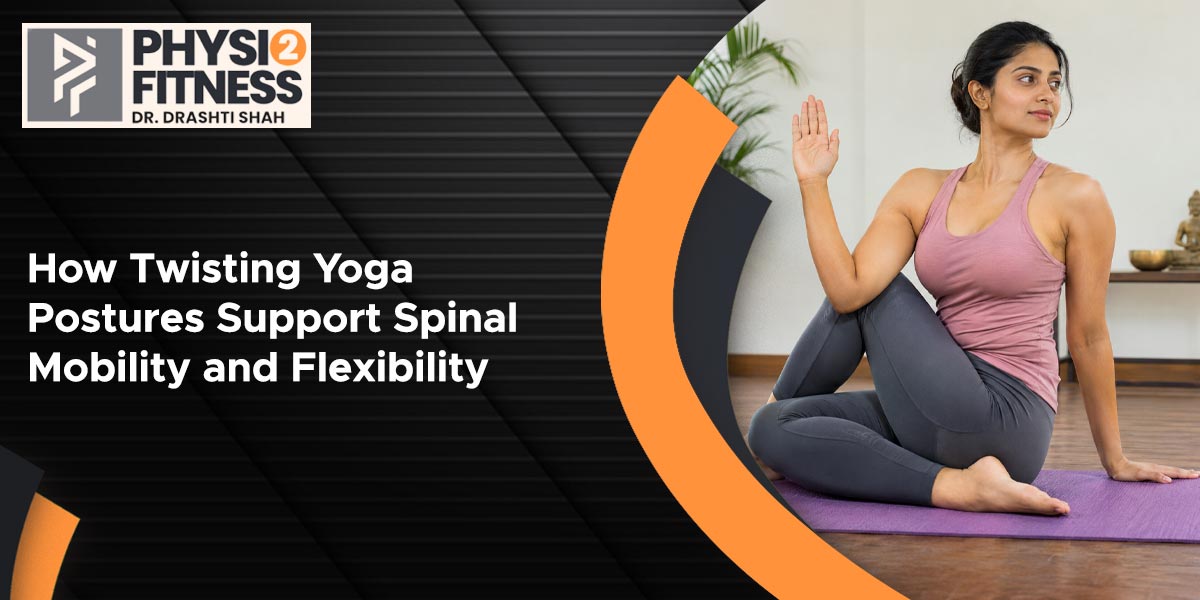
You’re at the dinner table when someone beside you says something funny. You turn to join in, feel a tug across your back, and shuffle your chair round instead. It takes a moment, but it can leave you wondering why such a small movement feels like hard work. When you come to Physio2Fitness for Yoga postures in Vadodara, that’s the kind of moment we want to hear about. It tells us much more about what you need than how far you can stretch on a mat.
Why turning can feel harder than bending:
You might bend down to tie your shoes quite easily, yet struggle to look over one shoulder. Bending forwards and turning ask different things of your back. As you turn, the part of your spine behind your ribcage helps your chest face a new direction. Your hips and neck can join in too. Think of turning to greet someone at the door. Your eyes go first, your chest follows, and eventually you move your feet.
At Physio2Fitness, we sometimes begin by asking you to fold your arms loosely and turn a little while seated. With your hands resting against your chest, you can feel when your ribs begin to move. You may discover that you usually turn your head quite far while your shirt buttons still face forwards. That small discovery gives you something you can actually feel and practise.
What a gentle twist gives you time to notice:
Flexibility is easy to picture when you think about reaching your toes. Spinal mobility is easier to feel when you turn towards an open window, pause, then come back to the middle. A gentle yoga twist gives you time to practise that whole movement. You learn where the stretch begins, whether you can breathe there, and how much effort it takes to return.
In our Spine physiotherapy treatment in Vadodara, we ask where you feel the effort. A gentle pull across the middle of your back is a different experience from a sharp catch near your waist. Both can make you stop at the same point. Hearing how each feels helps us decide whether to change your position, make the turn smaller, or examine what’s troubling you before continuing.
Three ways we ease into a twist:
At Physio2Fitness, we choose a starting position you can settle into without fuss. If sitting cross-legged makes your knees ache, you can use a chair. If you spend all day sitting and would welcome a few minutes lying down, a folded blanket and some floor space may suit you better. Here are three options we can explore together.
- A seated twist on a chair. Sit with both feet resting on the floor and cross your arms loosely over your chest. Let your chest turn a little as you breathe out. Pause where you can still take an easy breath, then come back slowly. Keep your hands away from the chair back so you can feel how far you can turn under your own control.
- A supported twist on your back. Lie on your back with your knees bent and feet together. Allow both knees to drift a short distance to one side. A cushion under your knees can give you somewhere comfortable to rest. If your shoulder begins to strain, bring your knees closer to the middle.
- A side-lying open-book stretch. Lie on one side with your head supported, knees bent and arms reaching forwards. Slowly sweep your top arm open, letting your chest follow. Your hand may stay well above the floor. Choose a spot where you feel comfortable, then bring your arm back along the same path.
What if one side feels tighter?
It can be frustrating when the first side feels easy and the second barely moves. During our sessions for Yoga postures in Vadodara, we give each side its own comfortable stopping point. Try noticing where the feeling changes. Does the stretch stay across your ribs? Does your shoulder start doing most of the work? That’s more helpful to us than the distance between your hand and the floor.
Finding a use for the movement off the mat:
Picture standing at the kitchen counter with a clean cup in your hand and the drying rack beside you. You turn a little through your chest, shift your weight and set the cup down. You probably give none of this a second thought until your back feels stiff. At Physio2Fitness, we use familiar tasks like this to understand which movements you’d like to feel at ease with again.
In our Full body functional workout in Anand, we can take the gentle turn you practised on a chair into a standing reach. We might start with an empty hand and an object placed beside you at waist height. You have room to move your feet and discover how your chest and hips can share the turn.
Our Full body functional workout in Nadiad gives us another way to work towards a favourite activity. If you miss playing badminton, for example, we can begin with the turn you use to reach for a slow shot. Your goal gives the practice a purpose, especially on days when another set of stretches holds little appeal.
Knowing when to pause:
If a twist brings on sharp pain or sends pain down your leg, ease out of the position and stop. If you have osteoporosis, a previous spinal fracture or a recent back injury, ask for individual advice before trying these movements. At Physio2Fitness, our Spine physiotherapy treatment in Vadodara gives you space to describe what happens, including how your back feels after the movement ends.
Progress you might notice on an ordinary day:
Through our Full body functional workout in Anand, we often bring the conversation back to the task you chose at the start. Perhaps you wanted to sit through Sunday lunch and chat comfortably with the person beside you. Being able to turn, listen for a moment and face forwards again gives you a clear way to judge how your practice feels.
When we plan your Full body functional workout in Nadiad, we also ask what fits into an ordinary week. You might enjoy a supported floor twist after a walk but prefer a chair on a busy workday. Having a familiar option for each setting can make practice feel manageable, even when you have little time to spare.
At Physio2Fitness, we’d like you to bring us one small example of a turn you’ve started avoiding. Perhaps it’s reaching for your bedside lamp or looking round when a friend calls your name. We can start with that movement, find a position where you feel at ease, and give you time to get familiar with turning again. You don’t need to arrive feeling flexible. A chair, a little room and a movement that matters to you are enough to begin.


